Clue 017
One observation from The Full You Field Guide.
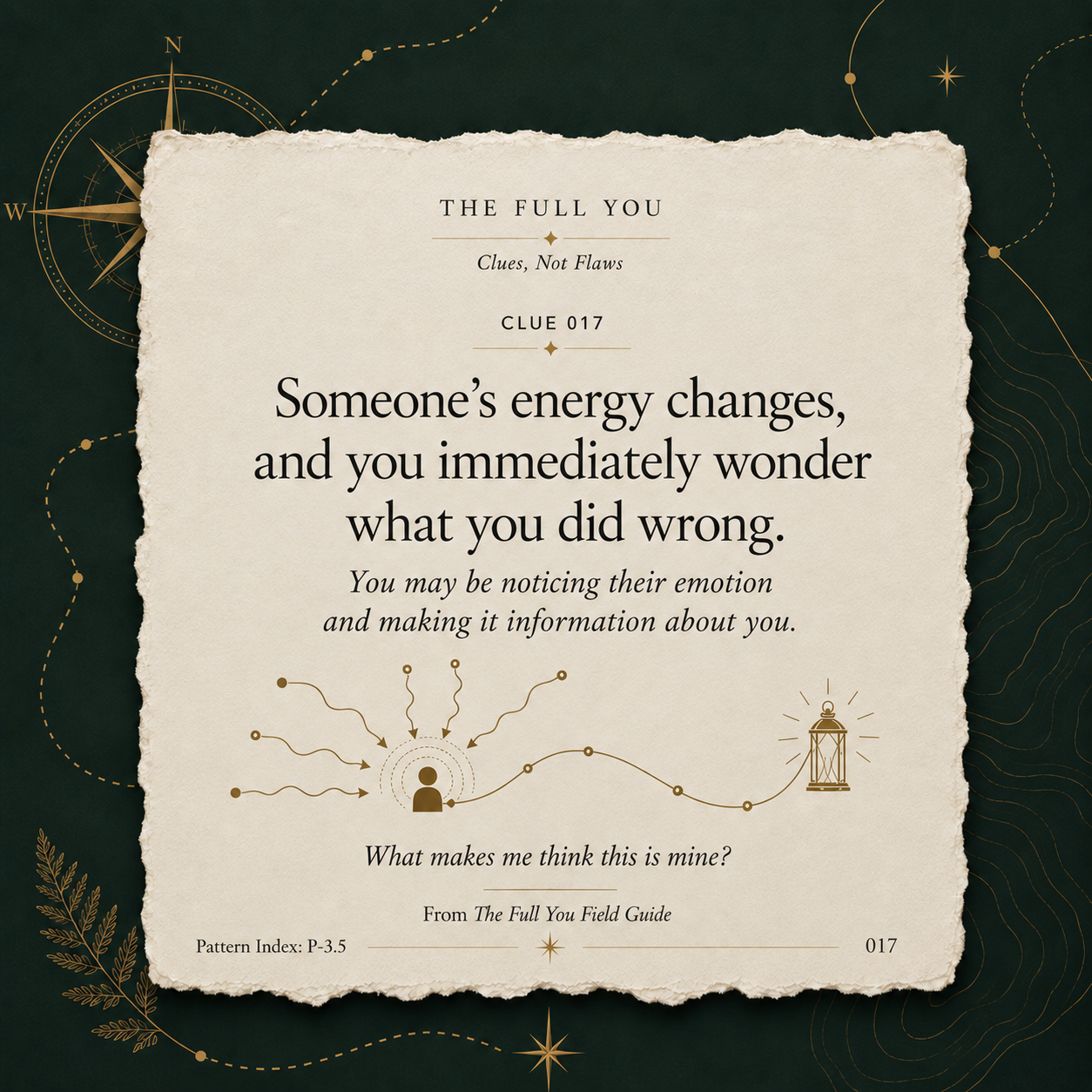
Someone’s energy changes, and you immediately wonder what you did wrong.
Pattern Index: P-3.5
They seem quieter or pulled away for some reason. Short text messages or messages left unanswered. Their tone seems different, and you notice it all.
And almost immediately, your attention turns inward.
- Did I say something?
- Are they upset with me?
- Did I overstep?
- Did I do something wrong?
You replay the last conversation and look for the moment things might have changed. Maybe you become extra agreeable, or maybe you simply check in. You find yourself explaining something that didn’t need more explanation. Maybe you just carry the uneasy feeling around until they seem like themselves again.
And sometimes, of course, someone’s mood does have something to do with us.
But notice how quickly your mind assumes it might.
That’s the clue.
What this might be pointing to
Somewhere along the way, you may have learned to pay close attention to other people’s emotional ups and downs.
A change in tone mattered to you. A withdrawn parent, irritated partner, unpredictable household, critical boss, or relationship where connection could suddenly feel uncertain may have taught you that noticing shifts early was useful.
You are so good at reading a room. Maybe too good.
The problem is that the skill can stay switched on even when you no longer need it.
Someone can be tired, distracted, worried about money, thinking about work, feeling sick, or simply having a bad day. Yet your mind still begins its investigation with:
Was it me? What did I do?
The clue underneath the clue
This may not really be about being overly sensitive. It may be about responsibility.
How responsible do you feel for the emotional temperature around you?
How easily can someone else be disappointed, distant, irritated, or simply “off” without you feeling compelled to understand it, repair it, or make sure you didn’t cause it?
There’s an important difference between noticing another person’s energy and taking ownership of it.
You found the pattern. Now discover what may be underneath it.
The Clue Decoder helps you move beyond recognizing the behavior and begin understanding the need, belief, or protective response behind it.
Early access is $19. Private, self-paced, and yours to revisit.
You can notice without assuming, and you can care with zero fixing.
At some point, you can learn to let others have an emotion that you don’t immediately make into a fault of your own.
The next time you feel someone’s energy change and your mind starts searching for what you did, try noticing the very first assumption.
Not “How do I make this better?”
But:
What makes me think this is mine?
You don’t need to talk yourself out of the feeling. Simply notice where your mind went first.
Because that reflex may be telling you something.
Clues, not flaws
Follow the Clue
A clue does not give you the whole answer. It gives you somewhere to look next.
Thought Pattern Decoder
Notice the assumption that forms before you have any evidence — the reflex that turns someone else’s mood into information about you.
Decode a thought patternPersonal Operating System Map
See how your sensitivity, needs, and protective patterns fit together, including the habit of carrying responsibility for the emotional temperature around you.
Explore your Personal MapThe Disconnection Map
Notice what happens when you shape yourself around other people’s moods, and what helps you return to your own.
Explore your Disconnection MapReceive the next Clue
The Clues are short observations from The Full You Field Guide—shared one at a time.
Subscribe to receive new Clues, writings, and resources from The Full You.
Receive future Clues